What is blue?
And is whatever it is the same for me as it is for you?
A scientist might state that blue describes:
'colours perceived by humans observing light with a dominant wavelength between approximately four-hundred-and-fifty and four-hundred-and-ninety-five nanometres',
Which may well tell us how blue can arise -
In the human mind, when a certain type of electromagnetic radiation enters the eyes.
But this does not, I think, tell us what blue really is.
For how can we be sure
That the imagined colour that my mind selects in its constant rush
To paint upon its ever-changing canvas
Comes from the same small pan into which you dipped your own brush.
You can say that blue is the colour of the sky (by day at least),
Or of the vast expanse of open sea (mostly),
Or the shirt worn by the best team (certainly not).
But what if you see all of those as I see green?
(and then we agree - those shirts belong to by far the greatest team the world has ever seen).
So what is blue?
To me, or to you?
To complicate matters further...
Blue could refer not to colour but, rather, to the tone of my thoughts.
But if I tell you that, just now, the thoughts inside my head are blue,
How do you know whether I am simply feeling a little down on my luck,
Or whether my mind, unleashed, is filled with images of a naked couple
?
Again, we come unstuck.
We must agree then, I think, to put aside all ambiguities
And to take the definition, with all of its nanometres, at face value.
Then we can label the sky as blue and the sea as blue.
We can assume my mood is melancholy even if it is really full of sauce.
And we can move on.
(although, we will never agree about those shirts of course.)
(c) Tim O’Hare, September 2023
About this poem: I’m not entirely sure where the idea for this poem came from but I guess I just liked playing with the words and the rhymes and bringing together some threads from different aspects of my life – science, perception, atmosphere, ocean, sports.
It was the morning of the fourth day of July, Twenty Twenty-three,
And I was running, alone, on Ilkley Moor.
I could not take the path that I had planned,
For it was stolen from me by the grasp of ferns.
And so, instead, I found another way to travel west,
My route, like life, a path of unexpected turns.
As I drew level with a group of trees, planted in my mental map, I turned,
To head, almost a scramble, up the rock-strewn slope,
Until, with the ground flattening all around, I came to a stone wall,
And followed a well-worn path that lay in its shadow, east towards the radio mast.
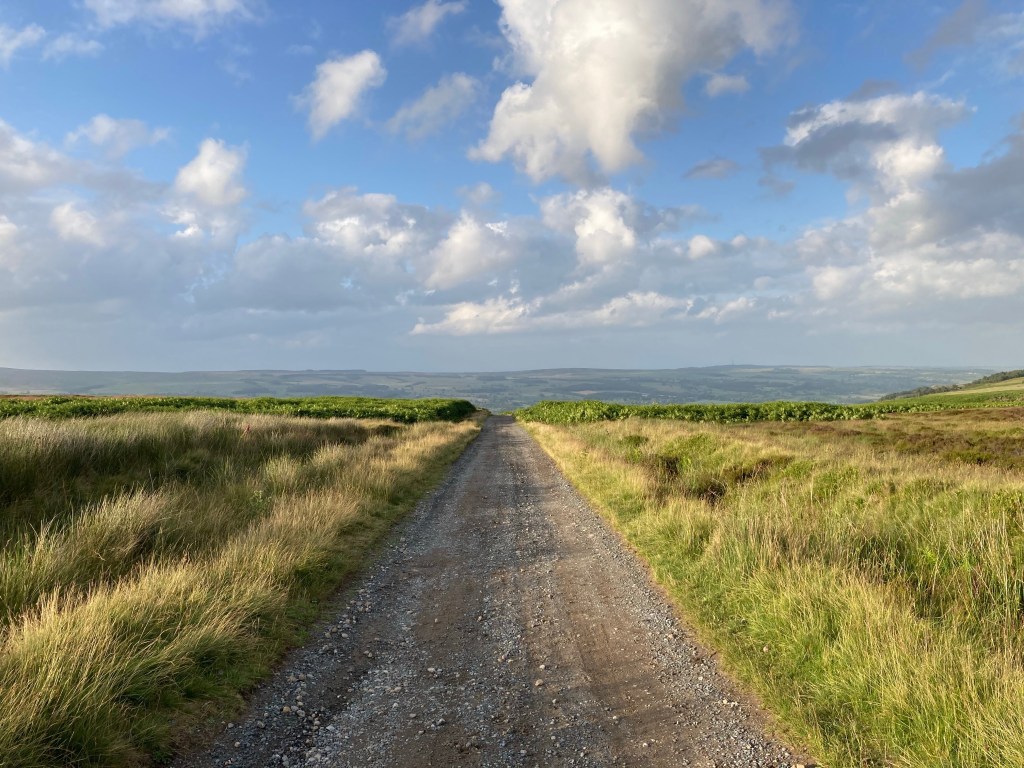
And there I knew my way, down the track they call the Keighley Road,
With a view across the valley over Ilkley town that, like the passing of a life, would slip away too fast.
As I began my descent, his profile came into view,
To my right, just off the track, though still some distance well ahead.
A small, dark man, sitting, gazing directly across my path,
Chin resting on hands, elbows propped on knees, his head straining forwards as if to peer through time to seek some other space.
He remained there as I closed, his features sharpening in my sight,
And I was struck how, like so much else in life, his presence was incongruous, for this did not seem to be his place.
I expected him to move as I approached, if only to shift his pose,
But he sat, looking west across the track, across the moor, still.
And as my eyes searched for detail in his form, I saw that he was too small, about two-thirds the size of a man, and so dark, yet without colour.
My brain was screaming at me that “something is not right here”, and I felt the heavy weight around me of the air.
I continued on, towards the point beside the grey stone on which he sat,
My heart was beating fast, prepared to meet another life,
but on my arrival there was no-one there.
The Keighley Road on Ilkley Moor (looking towards Ilkley)
(c) Tim O’Hare, August 2023
About this poem: This poem tells the true story of an encounter that I had on a morning run while staying on Ilkley Moor for a week. There was a rock on the verge by the track that I ran along as I made my descent to our holiday let. But as I came down the track towards it I saw the small, dark man sitting there, just as I describe in the poem and I instinctively felt that I was not able to recognise all that lay before me. Even now, more than a month later, I cannot let go of the fact that he was there and that, just for a few moments, either he or I was not in the right place.
You have used me as you wish to have your fun,
Scrabbling roughly on the pockmarked surface of my skin,
Climbing high to turn your face towards the sun.
You scrape your boots across me to remove accumulated soil,
Carving your initials in my surface,
Giving little thought to what you spoil.
You have taken from me what you need,
Using iron picks to gouge out fragments,
Thinking that you caused no pain because you saw no sign I bleed.
You turn your eyes towards me and see only solid rock,
Looking down upon my dumbness,
Laughing as you mock.
By day, as you approach from the grassy slope below,
You start to notice many shapes of things you know.
You see an outline that reminds you of a faithful hound,
You watch it shift as you move forwards, then it’s gone without a sound.
You turn to view a castle, but no soldiers move for they have fled,
You move your head to shape a profile, only then you see the witch’s head,
You trace out furrowed brow, hooked nose and jutting chin,
You feel grey eyes look through you, and you shiver as an evil spell takes hold within.
At night, in your imagination, led by an unheard call,
You see me rise up from my station, as I yawn and stretch so tall.
You hear the distant thunder of my steps, as I march the slowest beat,
You sense vibrations deep below, the trembling ground beneath my feet.
You are frightened of my power, as I tear the earth apart,
You are petrified, turned solid as the terror grips your heart,
You are fearful that I come at last to take what I am due,
You sense that it is time, and you are terrified that I am hunting, hunting now for you.
But none of this is true,
For all that you see and everything that you imagine
has been shaped by the stories you were told and what they let you do.
Those imagined forms, the wild thoughts and all the feelings they produce
may seem fantastic when compared with what is in your normal view.
So, what is the truth? If only you knew…
I was formed from countless tiny pieces that began as dust,
Mixed together in her bowl,
Baked by her heat to form a crust.
I was once pressed tight together as I found my solid form,
Extruded by her shuddering contractions,
Melded in her womb so warm.
I have rested for so long as if I have no task,
Snuggled by her mossy blanket,
Wrapped protectively within her grasp.
I have waited patiently for several million years,
Cooled by her gentle whispers,
Washed clean by her falling tears.

For your time is not all time.
Your whole existence is the smallest fraction of my life.
This place was mine so long before you came,
And it will remain my home for even longer once you die.
And your space is not all space.
Your whole world is like a single speck of the quartz that shines,
Within the substance of my form.
Just one of countless millions of specks all of which are mine.
And your thoughts are not all thoughts.
Your thoughts are small and they are fleeting and so they rarely bend,
You are constrained by what they choose to tell you.
There is so much you cannot comprehend.
And your life is not all life.
Your life is short and it is fast and so it limits what you try to claim,
You cannot grasp the unfamiliar.
You are bound by the rules that shape your game.
Believe me. I do not lie. I do not speak to garner fame.
For beyond all that you can see and everything that you imagine,
Are stories to be told and things to see that far expand your frame.
You may think you are the only one who holds within a spark,
But that is falsehood as we share that conscious flame.
I too am alive, and Rock Giant is my name.
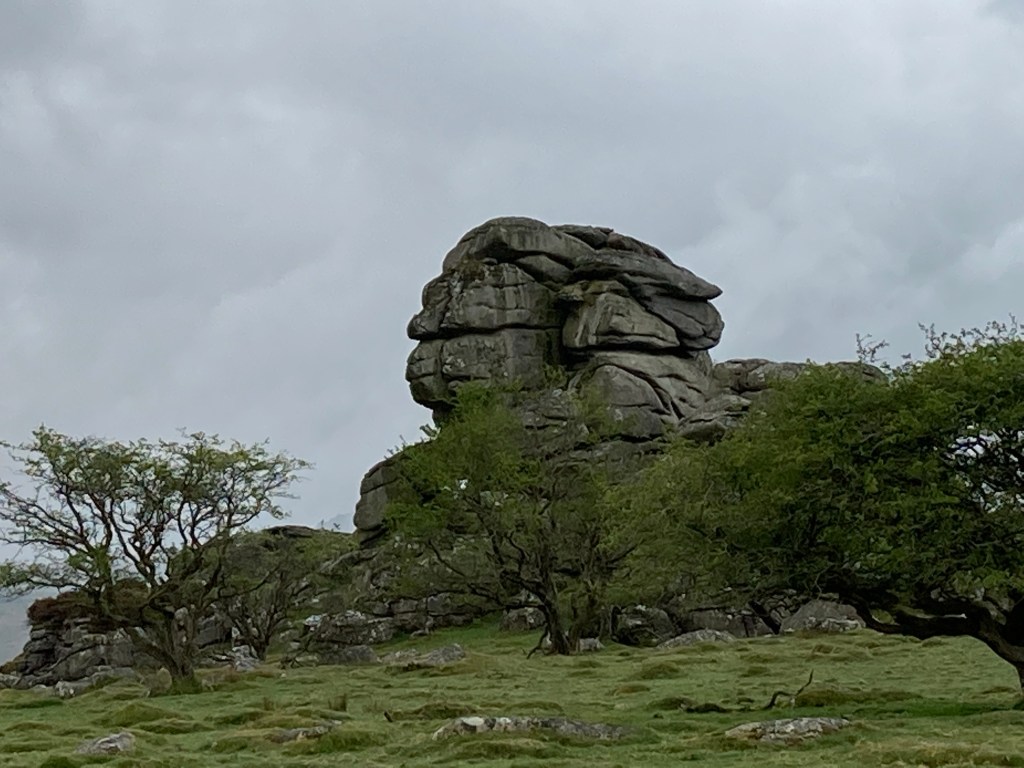
A Rock Giant on Dartmoor
(c) Tim O’Hare, August 2023
About this poem: The last few walks that we have done have been on the familiar territory of Dartmoor, taking in one or more of the rocky tors that sit atop many of the hill summits. These enormous piles of granite slabs are the remnants of old volcanoes, material pushed upwards from the upper mantle almost 300 million years ago. I find it impossible to visit a tor without seeing the profiles of faces in the shapes made by the great piles of rocks or imagining that the rocks are the tip of a toe, an elbow or some other part of a huge stone giant asleep beneath the ground. And then, in a natural progression of my thoughts, those rock giants begin to stir. I am not at all sure why, in the poem, I imagined the rock giant as a threat as my instinct is that they are, in fact, very gentle and friendly creatures. But, of course, I will never really know, because they still have much sleeping to do before they awaken.
This is the killing field,
But the danger does not come to you or me
From the piercing horn of a bull’s rush,
The digoxin punch of a fox’s glove,
Or a saliva-damp kiss from a cow’s lip.
This is the killing field,
But the danger does not come to you or me
From the aconitine grip of the wolf’s bane,
The spicular burn from a nettle’s leaf,
Or a sudden unexpected stroke of a pony’s tail.
This is the killing field,
And just for once, the danger does not even come
From those who strip the land to build and burn,
Who work the soil to plant and grow,
Who take whatever they wish to take,
Who go wherever they wish to go.
This is the killing field,
But the danger does not come to you or me.
It comes to the little creatures that scuttle and slither over ground,
Or paddle at the water’s edge,
Or take flight into the humid air,
Or hide away within the sedge.
For they refused to yield
To kiss the ground before the wise birds’ shrieks,
And so were baited by the raptors’ curse.
This is the killing field,
But the danger does not come to you or me.
It comes to the mouse, the rabbit and the vole,
Not fast enough to find a hole,
The beetle, grub and dragonfly,
Left with no escape to try,
The snake, the newt, the toad, the frog,
Too slow to get beneath a log,
And the pigeon, finch and moorhen chick,
This time, insufficiently quick.
This is the killing field,
And for all the little creatures that you love,
Death comes unheralded from far above.
First comes
Buteo buteo (Buzzard):
Mightiest of all,
Soaring high in thermal plumes,
Before swooping down,
To grasp in taloned feet
The unfortunate prey it must consume.
Then comes
Circus aeruginosus (Marsh Harrier):
Not far behind in stature and power,
Ranging low,
With undulating flight,
Before entering the reed bed,
To pluck out
The tiny creatures hiding there in fright.
But not all threats require wings of such size, for now come
Falco tinnunculus (Kestrel):
Fast wings,
Steady hover,
Sharp eyes,
Before falling like a stone,
To pounce
With great surprise
And
Falco subbuteo (Hobby):
Wings swept,
Swift flier,
Thrilling chase,
Before making the snatch,
To prove
That it has won the race.
An optimist might think
That the setting of the sun
And the falling of the dark
Could bring respite.
But this is the killing field,
And the danger comes both day and night.
For now, in fading light, comes
Tyro alba (Barn Owl):
Heavy flaps,
Ghostly glide,
A pause upon a post,
Before the sudden drop,
To make the surprise visit
To its host.
Then, as darkness gathers like a cloak, comes
Athene noctua (Little Owl):
Sitting,
Watching from a lofty perch,
Shattering the silence with its screech,
Before flying down,
To snaffle up
Whatever it can reach.
And finally, with all light gone, comes
Strix aluco (Tawny Owl):
Master of the dark,
Night vision goggled,
Waiting patiently with hunting ears,
Before pouncing,
Silently,
On each and every morsel of a meal it hears.
This is the killing field,
But the danger does not come to you or me.
The danger comes from far above,
From birds named with gladiatorial sounding words:
Buteo buteo and Circus aeruginosus:
Majestic Buzzard and Marsh Harrier
Falcos tinnunculus and Subbuteo:
Agile Kestrel and Hobby,
Tyro alba, Athene noctua and Strix aluco:
Barn, Little, Tawny - the three wise owls.
This is the killing field,
And the danger comes with such beauty and grace,
That seeing Death has never before
Put such a smile upon my face.
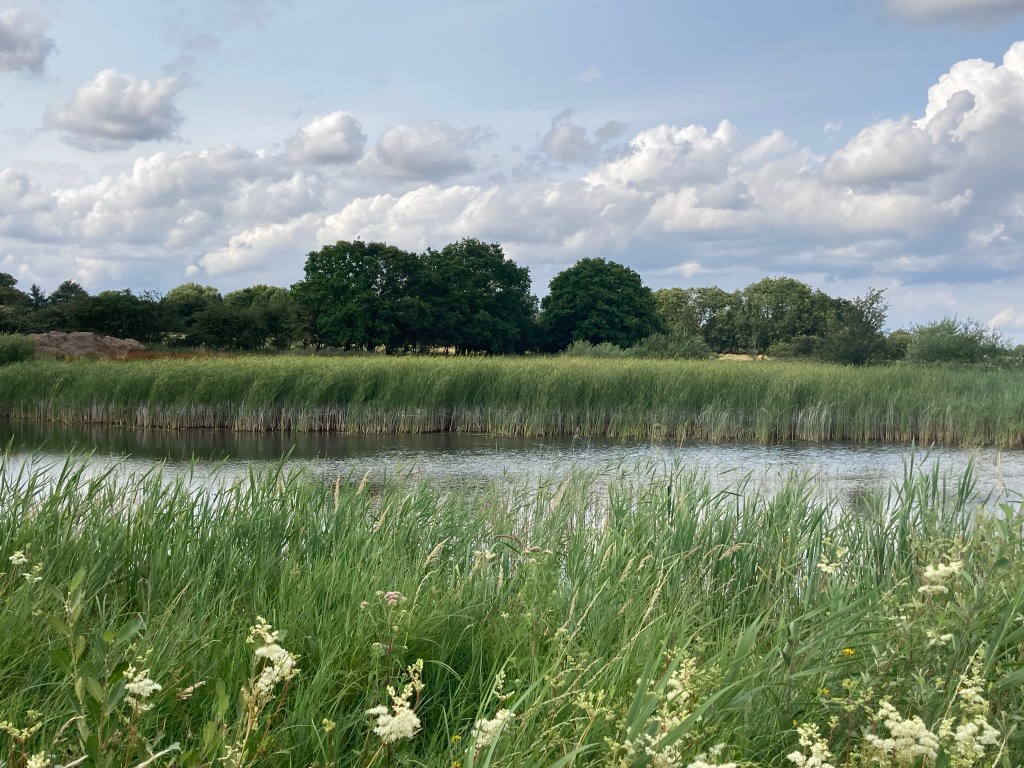
Reed Beds at Redgrave and Lopham Fen – The Killing Field
(c) Tim O’Hare, July 2023
About this poem: While staying in Suffolk during the second week of our summer holiday we walked around Redgrave and Lopham Fen one afternoon. Having seen various birds but not being entirely sure that I had been able to identify them all correctly I made sure that we went back for a second look and I was really thrilled to confirm my first ever sightings of a Marsh Harrier and a Hobby along with the oft-seen Buzzard and Kestrel. These are all beautiful birds and it was fascinating to watch their different flight patterns and to look up information about their diets and hunting styles. But it struck me quite forcibly that with that beauty and guile came death and the idea that the area around the fen was a ‘Killing Field’ took root in my head. During our stay we also heard or were told of the whereabouts of several different species of owls – the evening and night hunters – and so I threw those into the mix too.
I spied you threading your way up the narrow ghyll,
Just down there where the waters tumble over rocks on their long route down to the sea.
I watched you picking your way along the stoney path,
Stopping to rest awhile under the shade of that old, wizened tree.
I sensed that with each step of climb, up, up, onto the high moor,
Your mind opened like the land and all of your thoughts broke free.
I was amused to observe you pause now and then, looking about to take in the sights,
Knowing that you had not yet seen me.
You think this land belongs to you,
Your thoughts confirmed by the remnant workings and heaps of spoil the miners left behind.
You see evidence all around, backed up by the words on the pages of your guide,
That this remote corner of the world is here for humankind.
You sense that there are creatures here and rue the fact that they hide from view,
Wishing they’d show themselves so that you can tick them off the list you carry deep inside your mind.
You imagine how it must have been to dig into this land, with the dust, the noise, the aching limbs,
To bring out the ore enriched with the heaviest metal one can find.
And then, at last, you catch sight of me as I stand waiting patiently beside the stream.
I thought you’d never notice, so deeply did you dream.
You stop and, stretching out one arm, guide your companion’s sight,
You speak in hushed voices, moving slowly so as not to create fright.
I shift my weight a little and turn my head to best present myself to you,
For there have been many others who have stopped to see this profile view.
And trust me, I know what to do.
Stick-like legs, beneath my plump grey body, surprisingly large when seen close by,
Arching neck, dagger bill, the crown of feathers that adorns my head,
all of this can make you sigh.
And, of course, I know only too well, that what you really want is to see me fly.
So, I rouse myself fully, unfurl my mighty wings
And with three swift beats I am up and away,
Hammering the air as I move along the stream until,
Tantalisingly out of sight, I find another spot to stay.
Twice more I lead you on our little dance.
I fly upstream and you advance.
You are thinking that there must be only meagre pickings in such a small and insignificant stream as this,
And that to sustain so large a body I must have to spend an age to find a useful meal from tiny fish,
And that to live here as I do must be so hard and pose a lot of risk,
But there are things that you don’t realise, sights that you have missed.
This is the miners’ land no more, and you are only passing through,
And things are not exactly as they seem,
For the land you see around you, all the hills, the rocks, the fields, the walls,
And each and every one of the countless little streams,
Has a mighty ruler who has chosen to be at its helm,
And you, my passing admirer?
You are welcome in my realm.
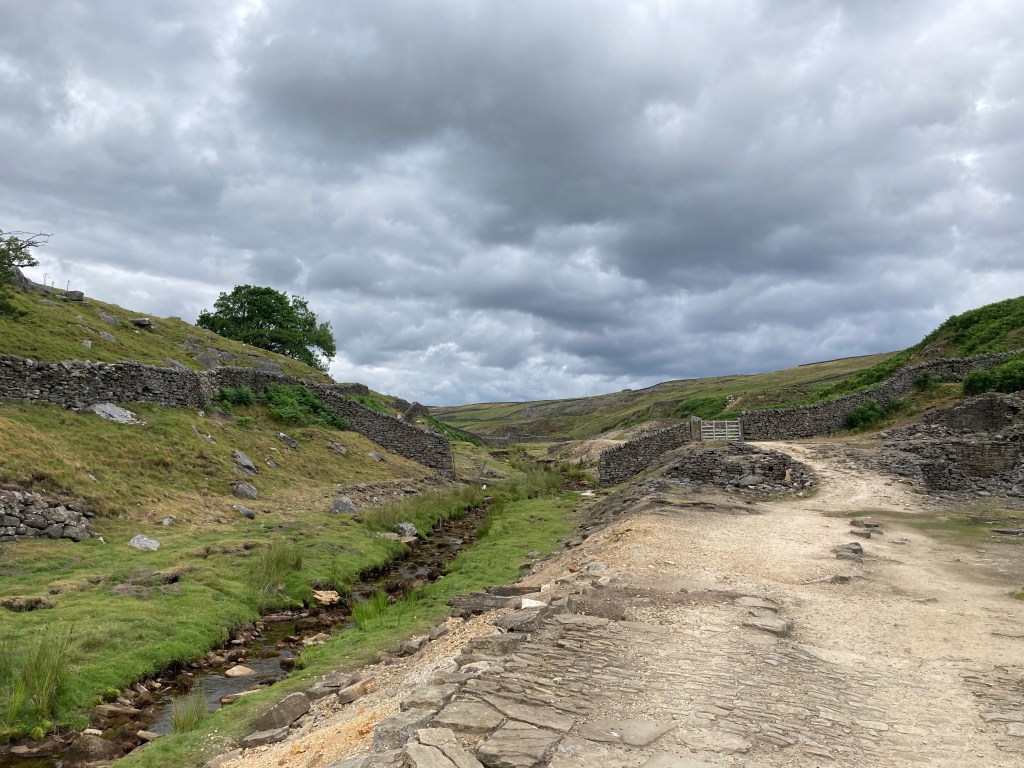
Hebden Ghyll – The Realm of King Heron
(c) Tim O’Hare, July 2023
About this poem: This poem was inspired by the sights experienced and thoughts that occurred during a wonderful walk while on our summer holiday in Ilkley, Yorkshire. The route took us along the valley of the River Wharfe and then north for lunch at The Old School Tearoom [highly recommended] in the village of Hebden. From there we slowly made our way up Hebden Ghyll, a narrow valley that was once the location for extensive lead-mining activities. As the terrain opened up to the expansive higher moorland I saw a heron standing at the side of the small stream than ran down the ghyll. We stood and watched it for a few moments and I commented that with the stream being so narrow it must offer slim pickings and that it must be hard for such a large bird to sustain itself there. Then, of course, the heron did what herons always do…
I don’t know if it is the air:
Clean and fresh like an ice-cold beer, bubbles rising, condensation on the glass,
Enough to quench the fiercest thirst;
Because sometimes…
It’s more like warm flat ale, the dregs of a barrel,
Forced down, because it cannot possibly go to waste.
Maybe it’s the trees:
Aged beings, firm trunks, twisting branches, rustling leaves,
All kinds of greens - magic matter drawn from thin air;
Although sometimes…
I am not so keen, when a dipping twig catches me in the eye,
Or a gnarly root sends me sprawling to the ground.
Perhaps it is the quiet:
Only the soft, gentle, companion sounds to the peacefulness of nature’s play,
The babbling of a stream, the stir of swaying grass, the lowing of distant beasts;
Although sometimes…
The incessant cawing racket of jackdaws, batters my ears and interrupts my calm,
Far more acutely than the hum of traffic or the playground shrieks of children.
It can also be the smells:
Sweet fragrances of flowers, fresh cut hay, that first exhalation of dry soil after a sorely-needed drink of rain;
Although sometimes…
There are certain emanations, animal and vegetable that have me rushing to hold my nose.
I wonder whether it is the sky:
Deep blue, adorned with a constantly changing dance of clouds,
Then fading to burning orange before the deepest black be-jewelled with silver stars;
But sometimes…
Such vastness can be far too much,
For this brain to consume in one sitting.
It’s definitely the route:
Words in the book, lines upon the map, places to stop for a view,
A little piece of history, a drink and a big piece of cake;
Although sometimes…
The wrong words have been used, those lines have simply not been drawn in the right places,
And the much-anticipated tea shop is closed, just because it is Wednesday.
It’s tempting to think it is the solitude:
Just me and the hills and the trees and the birds and… and… and…
Although, if I am really honest, I will admit that sometimes…
That can also be a state of loneliness.
In any case, it’s certainly also the companionship:
Sauntering along, side-by-side, ahead, behind,
Talking about the world around us, solving problems, making plans;
Although sometimes…
You just will not walk at the right speed and yes, I do know that I drive you crazy
Every time I stop to listen out for birds or to take one more arty snap with the app or the camera on my phone.
I think it could simply be the scale of it:
Always as far as the eye can see (and then beyond into the land of imagination),
Stretching back through an infinitude of whens and forward into yet more thens;
Although sometimes,
As truly awe-inspiring as that can be to consider,
I’m reminded that really there is only here and now.
So it seems to be the all of it:
Air, trees, quiet, smells, sky, route, solitude, companionship, scale and more, a little piece of all of the everything that has ever been,
Regardless of whether I, and all the others just like me, am here to do my worst whilst all the time I try to do my best.
Because we can build things, shape things, sell things and waste things,
But when I take a walk outside, away from all the stuff,
And when I allow myself to forget what I think I am, just for a moment,
Well then I am home.
The All Of It – ‘Home’
(c) Tim O’Hare, July 2023
About this poem: Our summer holidays tend to be based around walking in nature and I always find that this activity helps my brain to slow down and provides a great source of nourishment for my thinking. During the process of writing ‘Home’ I reflected on what it is that makes walking in nature such an important and grounding activity for me and as I ran through various possibilities and found counter-arguments for each one I came to realise that there is no single magic ingredient – it was simply that walking in nature was where I felt most at home.

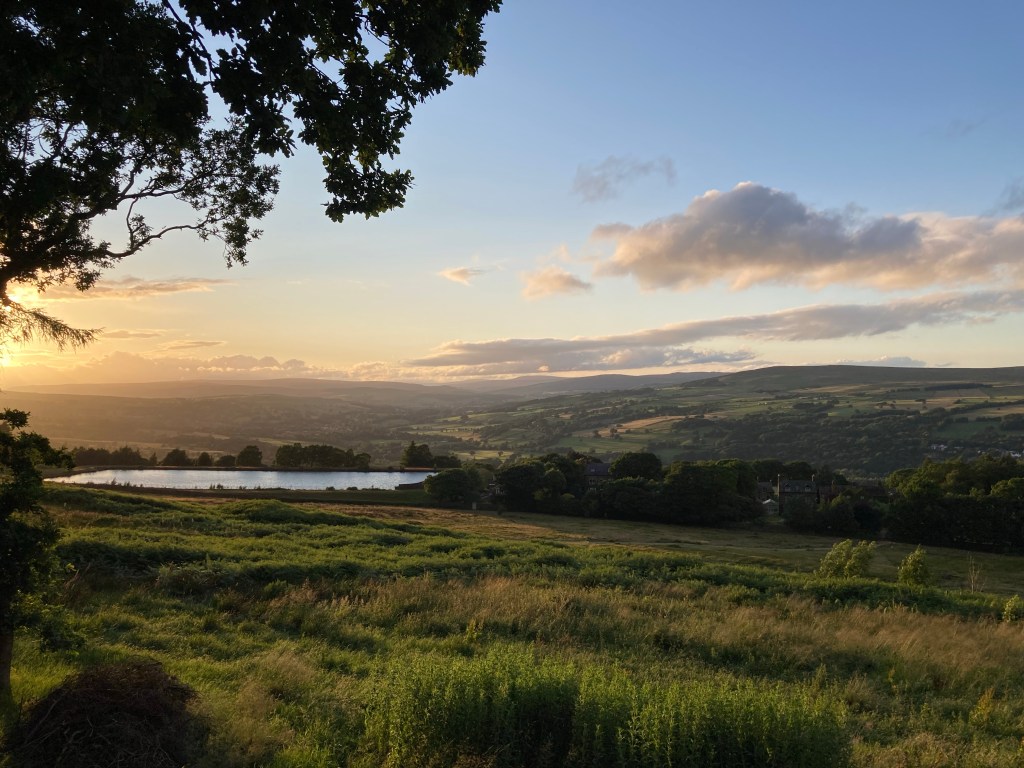
 and a poet