I am the square peg in the round hole,
Jammed in,
Stuck fast,
Placed there by youthful naivety,
Forced down by the weight of expectation,
Held in place by the pressure of life’s demands,
Hammered home by the repeated blows of round pegs
That, although appearing far too large to fill such a seemingly trivial hole,
Are really too small to even touch the sides.
Yet, even in the tightest grip,
It is possible to wriggle and writhe,
Tiny movements that, though causing damage, breaks and pain,
Gradually, imperceptibly, ease the bind.
The needle must break the cloth to form the stitches of repair.
I am still the square peg,
Plugging the round hole,
Missing parts of my surface,
Diminished,
Wearing hidden scars.
But now I have worked my way loose,
And although I cannot know the planes and slopes of the land that lies outside,
I have seen it in glimpses,
And I am ready to slide out,
With freshly rounded corners,
Ready to roll.
(c) Tim O’Hare, September 2023
About this poem: This is another poem that came up on me out of nowhere and very fast. In some ways it is a direct continuation from ‘It Is Time’ but whereas that poem is about recognising that a point of arrival has been reached, Square Peg is more about being ready to start out on the next part of the journey.
A slow start to the day with plenty of time for my morning routine:
At least half an hour for reading, lots of different books –
some daily inspiration, a chapter of a long novel, a short story, some poetry,
and a few pages from a science magazine.
With a cup of black coffee (currently decaf) by my side
and frequent stops to record an idea
or note some words of wisdom I have spied.
Then, a dive into my Journal notebook (Moleskine, large, squared)
with my zero-point-nine millimetre Pentel twist-grip propelling pencil in hand,
scribbling away as my thoughts coalesce through the words I write
in a way I simply cannot understand.
At least two or three runs each week,
preferably (although not as often as I would like) out of the city,
even though I rarely feel that I want to go
and often set out wearing a frown.
Ideally working towards some future long-distance event that,
despite crowding in on me horribly as it approaches,
seems to be a necessary challenge,
albeit one reluctantly thrown down.
Having enough money to keep buying books –
titles I come across that interest and intrigue.
(For it seems that books are my favourite food
and provide me with much of the sustenance that I need.)
Not being hungry…
so, yes, please do bring me that snack
(real food of course, not a book!)
Remembering to drink water…
because going without it is something for which I really seem to have a knack
until it is too late, my body dry and brain shrivelled to uselessness by its lack.
Knowing what is coming up and having a plan for the hours and days ahead,
even though I know I will not follow my intentions,
will waste much of the day
and become frustrated with myself.
(It’ll be a complete disaster if I set off with no kind of schedule, instead.)
Getting outside into nature, trees, sky, clouds and all the rest of it
especially when there are big views.
It’s so much better for connecting with the world
than the constant processed diet provided by The News.
Talking out my thoughts.
(Even if you do not really want to listen,
as long as you nod every so often
and give a few prompts to keep me going
it will really help to boost my knowing and keep my ideas growing.)
Being the master of my own time and space
so that I can sort and sift my thoughts,
move slowly through the day
and know where I am and where I am heading.
Working at my own pace.
But also, not having to make too many choices.
(Although I will always have an opinion – I admit that’s true –
it is usually far better if you simply tell me what we’re going to do.)
Encouragement and praise,
(just the right amount and I have to believe that it is sincere)
Just like the ambrosia eaten by Gods it can be sweet and sticky,
so getting this one right is really tricky.
What doesn’t help is…
Losing sight of the things that help
Or forgetting that
even though I am certain of their value
I will often have to force myself to do them,
And that
with insufficient respect for myself
I will likely lack the courage to make sure that they happen
Enough.
(c) Tim O’Hare, September 2023
About this poem: As I allude to in my note for ‘The Hollow Man’ (and probably elsewhere) there are certain things I like to do each day or on a regular/routine basis that help me to maintain my level of functioning. I find that I can go for a few days without following my ‘morning routine’ but if I let things slip for any longer or fail to force myself out for a run or a walk in the countryside I start to unravel. ‘Things That Help’ captures some of these activities and ingredients that keep me in balance and, most importantly, the need to keep them in sight and to keep using myself to do them. I’ve come to think that everyone should write out their own list of ‘Things That Help’ and keep it in a prominent place as a reminder.
It is time to banish thoughts of giving up,
to be replaced by the comfort of giving in -
acceptance rather than flight.
to fold back the shutters,
emerging from the dark of night,
allowing in some light.
It is time to cease the role of the bully,
forcing the fearful child within,
to be the man he thought he should.
Instead, enfolding in a loving hug,
to draw out all he could have been.
If only he had understood.
It is time to give the boy a chance,
to give him space to play his part,
to let him fall and graze his elbow - blood and gravel -
even though tears may flow.
He may be strong enough.
How else will we know?
It is time to take those steps
that cross the threshold of that door,
to find that it was open all along,
never locked,
and behind it, the voice of the song,
oft heard, though always sounding slightly wrong.
It is time to push on through the fog,
that cloak of damp that so confuses senses,
seeking clearer skies,
different colours, other forms
to try on for size.
Who knows how those choices may surprise?
It is time to give in,
not to temptation, hopelessness or terror,
but to follow the path to those imagined lands,
shaping their form with my own hands.
Finally, he understands.
(c) Tim O’Hare, August 2023
About this poem: This poem came completely out of the blue, coalescing onto the page in less than an hour. It reflects a big decision made on the previous day – to signal that I must let go of a big role at work, to stop fighting with the thought that to do so was some kind of failure and to just accept that I no longer have it within me to push and cajole and fight with myself anymore.
It was the morning of the fourth day of July, Twenty Twenty-three,
And I was running, alone, on Ilkley Moor.
I could not take the path that I had planned,
For it was stolen from me by the grasp of ferns.
And so, instead, I found another way to travel west,
My route, like life, a path of unexpected turns.
As I drew level with a group of trees, planted in my mental map, I turned,
To head, almost a scramble, up the rock-strewn slope,
Until, with the ground flattening all around, I came to a stone wall,
And followed a well-worn path that lay in its shadow, east towards the radio mast.
And there I knew my way, down the track they call the Keighley Road,
With a view across the valley over Ilkley town that, like the passing of a life, would slip away too fast.
As I began my descent, his profile came into view,
To my right, just off the track, though still some distance well ahead.
A small, dark man, sitting, gazing directly across my path,
Chin resting on hands, elbows propped on knees, his head straining forwards as if to peer through time to seek some other space.
He remained there as I closed, his features sharpening in my sight,
And I was struck how, like so much else in life, his presence was incongruous, for this did not seem to be his place.
I expected him to move as I approached, if only to shift his pose,
But he sat, looking west across the track, across the moor, still.
And as my eyes searched for detail in his form, I saw that he was too small, about two-thirds the size of a man, and so dark, yet without colour.
My brain was screaming at me that “something is not right here”, and I felt the heavy weight around me of the air.
I continued on, towards the point beside the grey stone on which he sat,
My heart was beating fast, prepared to meet another life,
but on my arrival there was no-one there.
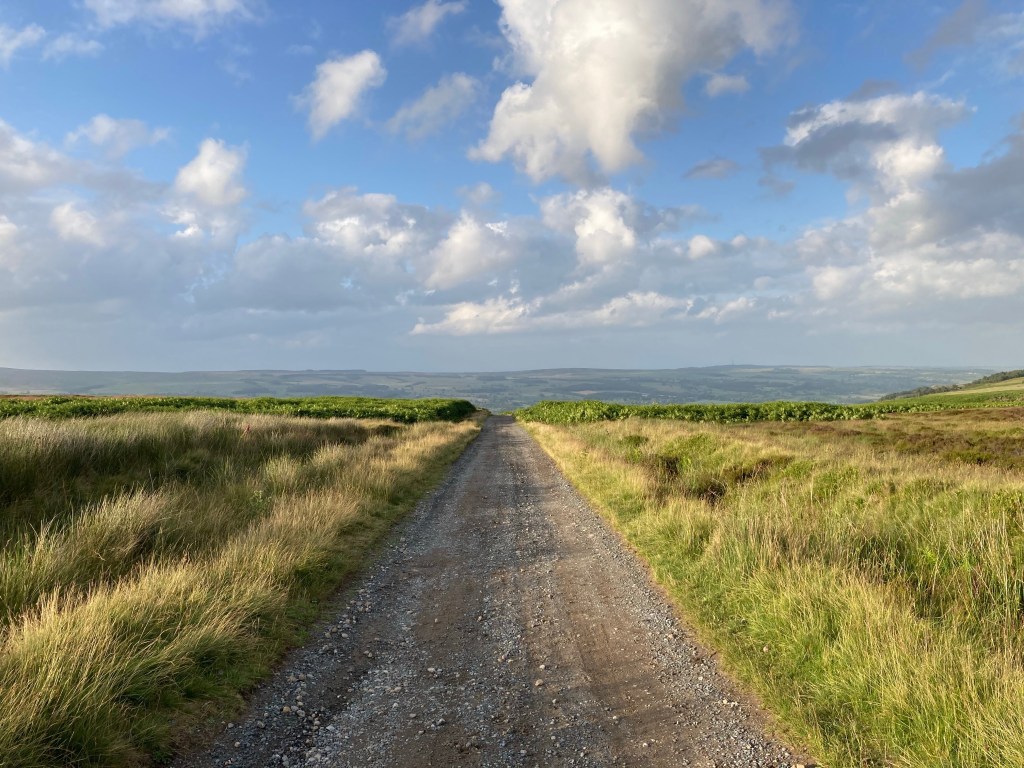
The Keighley Road on Ilkley Moor (looking towards Ilkley)
(c) Tim O’Hare, August 2023
About this poem: This poem tells the true story of an encounter that I had on a morning run while staying on Ilkley Moor for a week. There was a rock on the verge by the track that I ran along as I made my descent to our holiday let. But as I came down the track towards it I saw the small, dark man sitting there, just as I describe in the poem and I instinctively felt that I was not able to recognise all that lay before me. Even now, more than a month later, I cannot let go of the fact that he was there and that, just for a few moments, either he or I was not in the right place.
You have used me as you wish to have your fun,
Scrabbling roughly on the pockmarked surface of my skin,
Climbing high to turn your face towards the sun.
You scrape your boots across me to remove accumulated soil,
Carving your initials in my surface,
Giving little thought to what you spoil.
You have taken from me what you need,
Using iron picks to gouge out fragments,
Thinking that you caused no pain because you saw no sign I bleed.
You turn your eyes towards me and see only solid rock,
Looking down upon my dumbness,
Laughing as you mock.
By day, as you approach from the grassy slope below,
You start to notice many shapes of things you know.
You see an outline that reminds you of a faithful hound,
You watch it shift as you move forwards, then it’s gone without a sound.
You turn to view a castle, but no soldiers move for they have fled,
You move your head to shape a profile, only then you see the witch’s head,
You trace out furrowed brow, hooked nose and jutting chin,
You feel grey eyes look through you, and you shiver as an evil spell takes hold within.
At night, in your imagination, led by an unheard call,
You see me rise up from my station, as I yawn and stretch so tall.
You hear the distant thunder of my steps, as I march the slowest beat,
You sense vibrations deep below, the trembling ground beneath my feet.
You are frightened of my power, as I tear the earth apart,
You are petrified, turned solid as the terror grips your heart,
You are fearful that I come at last to take what I am due,
You sense that it is time, and you are terrified that I am hunting, hunting now for you.
But none of this is true,
For all that you see and everything that you imagine
has been shaped by the stories you were told and what they let you do.
Those imagined forms, the wild thoughts and all the feelings they produce
may seem fantastic when compared with what is in your normal view.
So, what is the truth? If only you knew…
I was formed from countless tiny pieces that began as dust,
Mixed together in her bowl,
Baked by her heat to form a crust.
I was once pressed tight together as I found my solid form,
Extruded by her shuddering contractions,
Melded in her womb so warm.
I have rested for so long as if I have no task,
Snuggled by her mossy blanket,
Wrapped protectively within her grasp.
I have waited patiently for several million years,
Cooled by her gentle whispers,
Washed clean by her falling tears.

For your time is not all time.
Your whole existence is the smallest fraction of my life.
This place was mine so long before you came,
And it will remain my home for even longer once you die.
And your space is not all space.
Your whole world is like a single speck of the quartz that shines,
Within the substance of my form.
Just one of countless millions of specks all of which are mine.
And your thoughts are not all thoughts.
Your thoughts are small and they are fleeting and so they rarely bend,
You are constrained by what they choose to tell you.
There is so much you cannot comprehend.
And your life is not all life.
Your life is short and it is fast and so it limits what you try to claim,
You cannot grasp the unfamiliar.
You are bound by the rules that shape your game.
Believe me. I do not lie. I do not speak to garner fame.
For beyond all that you can see and everything that you imagine,
Are stories to be told and things to see that far expand your frame.
You may think you are the only one who holds within a spark,
But that is falsehood as we share that conscious flame.
I too am alive, and Rock Giant is my name.
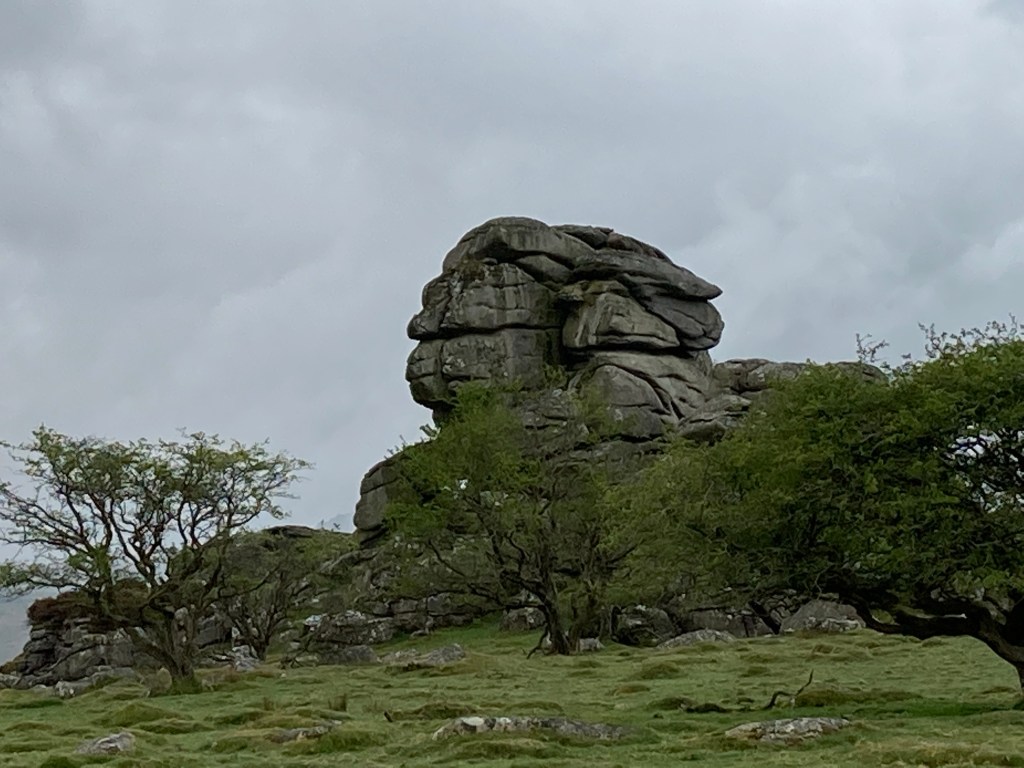
A Rock Giant on Dartmoor
(c) Tim O’Hare, August 2023
About this poem: The last few walks that we have done have been on the familiar territory of Dartmoor, taking in one or more of the rocky tors that sit atop many of the hill summits. These enormous piles of granite slabs are the remnants of old volcanoes, material pushed upwards from the upper mantle almost 300 million years ago. I find it impossible to visit a tor without seeing the profiles of faces in the shapes made by the great piles of rocks or imagining that the rocks are the tip of a toe, an elbow or some other part of a huge stone giant asleep beneath the ground. And then, in a natural progression of my thoughts, those rock giants begin to stir. I am not at all sure why, in the poem, I imagined the rock giant as a threat as my instinct is that they are, in fact, very gentle and friendly creatures. But, of course, I will never really know, because they still have much sleeping to do before they awaken.
He does not signal his arrival with a knock upon the door.
I am not warned of his entry by footsteps sounding on the floor.
He is not accompanied by wraith-like wisps of mist.
Nor does he lean in close to give my cheeks a loving kiss.
There is no movement as he slides into the room.
I only realise he is present when overcome by gloom.
For he is a master of disguise,
Sidling up to me, out of sight of prying eyes,
Until he has taken up his place,
Occupying every single atom of my space,
Matching every feature, to cast a shadow on my face.
He reshapes my breath to turn each exhalation into a sigh,
And cries tears upon my heart to dowse the flames and cause the fire to die.
If I am sitting reading in a chair he squeezes in to look upon the words,
And twists their meanings so that they transform, grotesquely and absurd.
If I am gazing from the window to catch sight of nature’s green,
He draws a veil across my eyes to wipe away life’s vibrant sheen.
If I am setting out upon a chosen path,
He conjures fog so thick and heavy that I cannot find the start.
If I have hopes to pursue a long awaited plan,
He shows me every obstacle and challenge that he can.
He breaks the bridges of my imagination so that they have insufficient span.
He was with me yesterday.
He is The Hollow Man.
He does not ask if it is convenient for him to share my time.
I have no say in this, the choice is his, not mine.
He does not consider for one moment whether I would like him near,
For if he needs my space he takes it with no fear.
He gives no thought to any impact that he makes.
It’s up to him to choose the one he takes.
For he is a master of deceit,
And if he needs to feed then he will eat,
Until he has taken all he grips,
Draining arteries with a thousand sips,
Sucking out the marrow through his lips.
He gnaws away until my bones are stripped of meat,
And leaves the empty carcass in a heap.
When he is with me all I feel is rank despair
I try to look ahead but only find a vacant stare.
When he is with me I can see no hope,
I cannot move as I would like, my walk becomes a slope.
When he is with me there is only cloud,
And I would even welcome then a deathly shroud.
When he is with me there is nothing you can say,
For I am empty till he moves away.
There is no weapon you can use to end his stay.
He is The Hollow Man,
And he will have his day.
Yet, he will tire and then as softly as he came,
I find that he has slipped away to leave me with my fragile frame.
And if I search with care for what lies buried in the depths,
I find that he has not quite stripped me as I slept.
For there are embers that still burn though feebly bright,
That, tended gently, provide new warmth that brings a light.
For he is a master who will make his mark,
And from those tiny flames out jumps a spark,
Until it catches on the dried-out skin,
Taking hold to make new flames begin,
Exploding with the hidden energy within,
Then, bursting outwards as a firework on its arc,
Until the world no longer seems so dark.
There is no fanfare as he leaves his host,
He simply slips into the ether to become another haunting ghost.
There is no note to say farewell,
No threat that he’ll return to cast his spell.
But I expect that he’ll be back,
That he will claw his way inside once more to turn my soul to black.
And strangely though his visits cause much strain,
The gift he brings is worth the pain,
And even though I shudder at his name,
I know with certainty that he will come again.
He is the slaughterer,
The one who feeds upon the lamb.
He is the emptier,
The one who draws out all the poison that has spread across the land.
He is The Hollow Man,
And I must welcome his arrival,
For he is part of who I am.
(c) Tim O’Hare, August 2023
About this poem: I would say that I am usually in a fairly positive frame of mind, but every so often and always without any real warning I find that I have slipped into a deep state in which I have absolutely zero motivation and can see no point whatsoever in doing anything at all. I become uncommunicative, I mutter, I trudge. I know that I am in this state but I am powerless to change things; in fact, in the moment, I don’t want to. The best way that I can describe how I feel is empty or hollow. Over time I have learned that this down phase passes and usually I wake the next morning feeling back to normal, better even, than I did before the dip. My energy levels shoot back up and I feel more inspired. ‘The Hollow Man’ was written on such a morning. After a terrible dip the previous day I had spent an hour or so reading, gone for a short run and emerged from the shower with the first two lines of the poem in my head. As soon as I could, I stood at my whiteboard, wrote out those two lines and then followed the seam to chip out the whole of the first verse. At that point I was thinking that I should stop, but I soon found myself at the computer typing in that verse and then, over the next couple of hours, all of the rest of the poem tumbled out. At the outset I had no idea that the poem would ultimately become uplifting (well I think it is uplifting!) and perhaps even a little profound.
I do not know if my poems are any good,
But it seems they help my essence to be understood,
Whether by others or simply by myself,
This last, of course, itself essential for my health.
I do not know if my poems are enjoyable to read,
But it seems that crafting them fulfils some vital need,
And that allowing thoughts and feelings to gush forth,
Provides a compass I can use to find my north.
It seems as if through searching for each rhyme,
I’ve stumbled on a way to slow down time,
And that through sculpting syllable-istic rhythm,
I now see the world in multitudinous ways, split infinite like sunlight passing through a prism.
And so, once more,
I drop into the mine,
To chip away and work the line,
To trace the seam right to its core,
And scrape out all the mineral ore.
I hammer hard to split a rock,
In hope it is a nugget-bearing block,
In hope it might just be the one to hold,
A precious, piece of sparkling gold.
I do not know if my poems hit the mark,
But certainly they’ve lit a spark,
So now the flames inside me roar,
And I can ask for nothing more.
Here goes…
First,
Time slows,
An idea flows,
Like water spurting from a hose,
The seedling grows,
The petals unfurl upon the rose.
I take my chance…
Falling deep into the trance,
Where visions glance,
Words prance,
And rhythms dance,
And then,
I emerge,
Life enhanced.
In those moments,
My whole world collapses onto a single spot.
So much energy compressed into a tiny dot.
Freezing cold yet furnace hot.
I do not know if my poems are any good.
I do not know if my poems are enjoyable to read.
I do not know if my poems hit the mark.

It matters not.
(c) Tim O’Hare, July 2023
About this poem: I had some nice feedback on the first few poems that I wrote but as this all came from people that knew me well it was impossible not to feel that it must be biased, even if only subconsciously. I began to think about whether my poems really were any good. This is the kind of thinking that usually drains my motivation and stops me in my tracks. But I have changed a bit in recent months and pondering this a little more I was able to acknowledge that whether or not anyone else liked my poems, I enjoyed the process of creating them and was learning about myself as I did so.
This is the killing field,
But the danger does not come to you or me
From the piercing horn of a bull’s rush,
The digoxin punch of a fox’s glove,
Or a saliva-damp kiss from a cow’s lip.
This is the killing field,
But the danger does not come to you or me
From the aconitine grip of the wolf’s bane,
The spicular burn from a nettle’s leaf,
Or a sudden unexpected stroke of a pony’s tail.
This is the killing field,
And just for once, the danger does not even come
From those who strip the land to build and burn,
Who work the soil to plant and grow,
Who take whatever they wish to take,
Who go wherever they wish to go.
This is the killing field,
But the danger does not come to you or me.
It comes to the little creatures that scuttle and slither over ground,
Or paddle at the water’s edge,
Or take flight into the humid air,
Or hide away within the sedge.
For they refused to yield
To kiss the ground before the wise birds’ shrieks,
And so were baited by the raptors’ curse.
This is the killing field,
But the danger does not come to you or me.
It comes to the mouse, the rabbit and the vole,
Not fast enough to find a hole,
The beetle, grub and dragonfly,
Left with no escape to try,
The snake, the newt, the toad, the frog,
Too slow to get beneath a log,
And the pigeon, finch and moorhen chick,
This time, insufficiently quick.
This is the killing field,
And for all the little creatures that you love,
Death comes unheralded from far above.
First comes
Buteo buteo (Buzzard):
Mightiest of all,
Soaring high in thermal plumes,
Before swooping down,
To grasp in taloned feet
The unfortunate prey it must consume.
Then comes
Circus aeruginosus (Marsh Harrier):
Not far behind in stature and power,
Ranging low,
With undulating flight,
Before entering the reed bed,
To pluck out
The tiny creatures hiding there in fright.
But not all threats require wings of such size, for now come
Falco tinnunculus (Kestrel):
Fast wings,
Steady hover,
Sharp eyes,
Before falling like a stone,
To pounce
With great surprise
And
Falco subbuteo (Hobby):
Wings swept,
Swift flier,
Thrilling chase,
Before making the snatch,
To prove
That it has won the race.
An optimist might think
That the setting of the sun
And the falling of the dark
Could bring respite.
But this is the killing field,
And the danger comes both day and night.
For now, in fading light, comes
Tyro alba (Barn Owl):
Heavy flaps,
Ghostly glide,
A pause upon a post,
Before the sudden drop,
To make the surprise visit
To its host.
Then, as darkness gathers like a cloak, comes
Athene noctua (Little Owl):
Sitting,
Watching from a lofty perch,
Shattering the silence with its screech,
Before flying down,
To snaffle up
Whatever it can reach.
And finally, with all light gone, comes
Strix aluco (Tawny Owl):
Master of the dark,
Night vision goggled,
Waiting patiently with hunting ears,
Before pouncing,
Silently,
On each and every morsel of a meal it hears.
This is the killing field,
But the danger does not come to you or me.
The danger comes from far above,
From birds named with gladiatorial sounding words:
Buteo buteo and Circus aeruginosus:
Majestic Buzzard and Marsh Harrier
Falcos tinnunculus and Subbuteo:
Agile Kestrel and Hobby,
Tyro alba, Athene noctua and Strix aluco:
Barn, Little, Tawny - the three wise owls.
This is the killing field,
And the danger comes with such beauty and grace,
That seeing Death has never before
Put such a smile upon my face.
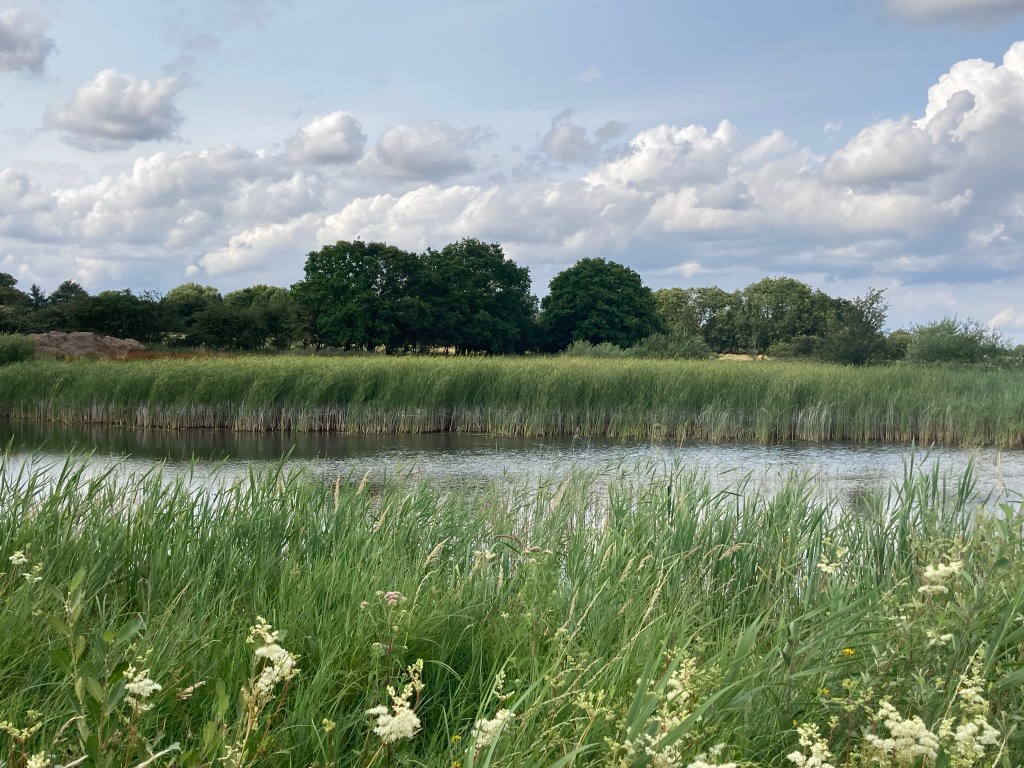
Reed Beds at Redgrave and Lopham Fen – The Killing Field
(c) Tim O’Hare, July 2023
About this poem: While staying in Suffolk during the second week of our summer holiday we walked around Redgrave and Lopham Fen one afternoon. Having seen various birds but not being entirely sure that I had been able to identify them all correctly I made sure that we went back for a second look and I was really thrilled to confirm my first ever sightings of a Marsh Harrier and a Hobby along with the oft-seen Buzzard and Kestrel. These are all beautiful birds and it was fascinating to watch their different flight patterns and to look up information about their diets and hunting styles. But it struck me quite forcibly that with that beauty and guile came death and the idea that the area around the fen was a ‘Killing Field’ took root in my head. During our stay we also heard or were told of the whereabouts of several different species of owls – the evening and night hunters – and so I threw those into the mix too.
There’s a hill marked on the map and so we will have to climb up,
And we follow the river along the valley so then we’ll be quite far down.
Let me see, there should be a church tower - yes, on the horizon, over there,
And that means that our path will go right then left twice and then another turn right.
Next to the fen marsh it will probably be a bit wet,
But the stretch along the beach should be sandy and dry.
That’s the car park, just in front, so…
Where’s the windmill? Behind us, out of sight.
It is helpful to be able to orientate yourself in time and space,
And a comfort to know that everything stands in order and has its rightful place,
Because, believe me, there is a problem if you don’t know which way you should face.
I think I’m pretty good at this so let me help you understand,
Left, right, up, down, in front, behind, parched or drowned,
The truth is that you must get to know the lie of the land.
No…sorry…wait…it’s not quite that simple…
That hill I mentioned is only five metres above sea level, it’s so low down that it can hardly be called a hill – it’s little more than a pimple.
The water in the river flows further down towards the shore, which means that the valley is actually up above the sea.
When we reach the church tower, it won’t be over there, it will be our here. Obviously.
And when we follow the path back, we will take a left, a right and after that we’ll go right then left again.
But it shouldn’t be too confusing because we’ll be on familiar ground by then.
This isn’t what I was expecting from the map on the visitor centre wall.
I guess there’s been so little rain recently that the marsh is bone dry, and there’s hardly any water in the drainage channels at all.
The tide must be on its way out, because there are shells and seaweed all along the shore and so the sand is salty wet.
Anyway, it’s been nice since we got away from the car park. I was pleased to leave that behind, all those cars and people made me fret.
So…Where is the windmill? Have patience, don’t get stressed…
Wait for it… ready? There, right in front. Are you are impressed?
It would be helpful if I could orientate myself in time and space,
And comforting if everything would actually get in order and into its rightful place.
Because, I definitely have problem when I don’t know which way I should face.
I thought I was pretty good at this but now things are getting out of hand.
Left, right, up, down, in front, behind, parched or drowned,
I’ve really been made a fool of here by the lies of the land.
(c) Tim O’Hare
About this poem: While staying in the Norfolk Broads during our summer holiday we drove out to the coast for a walk at Horsey Gap, parking the car near Horsey Windmill. On the way there I had been amused to notice that features that were named on the map as hills were, in fact, only a few meters above sea level and the idea that such naming was a ‘lie of the land’ was born. The poem picks up on various elements of the walk which took in fenland marsh, a beach (with seals swimming in the surf) and, of course, the windmill.
I’m just back in from my morning run.
Before I left she asked me how far I was planning to go,
And I replied: “Only about 3 miles, maybe thirty minutes or so”.
I showed her my intended route on the map,
So that in an emergency she could find me in a hurry.
As soon as I was outside, my mind was transported.
There were poppies and other wildflowers in the hay fields, faces turned to greet the morning sun.
I ran through swathes of wheat and barley waving in the breeze,
Reed beds down by the fen and woods with birds singing merrily in the trees.
But I had been far too optimistic and so I found I made several false turns,
Finding my way blocked, not wanting to squeeze my way through tick-infested ferns.
At one point I had to whisper my way past a group of young cattle
That barred my path, even nibbling at my shorts and, fortunately, that encounter did not end up as a battle.
Some people might laugh at my incompetence, but I have to disagree, because:
I was not lost,
Although I will reluctantly admit that I did not know exactly where I was.
But I don’t think it really mattered that I wasn’t quite where I’d expected myself to be.
Anyway, I’m back now,
And as soon as I came through the door I said “sorry”, because I didn’t want the atmosphere to sour.
You see, I had run five-point-four miles and been out for almost an hour,
And although she didn’t say anything, if past form is anything to go by,
I expect that she had started to worry.
My run gave me a chance to think, and realise that, even though things didn’t go entirely to plan:
I am not lost.
In fact I happily accept that I do not know exactly where I am,
Because it really doesn’t matter that I am not where I expect myself to be.
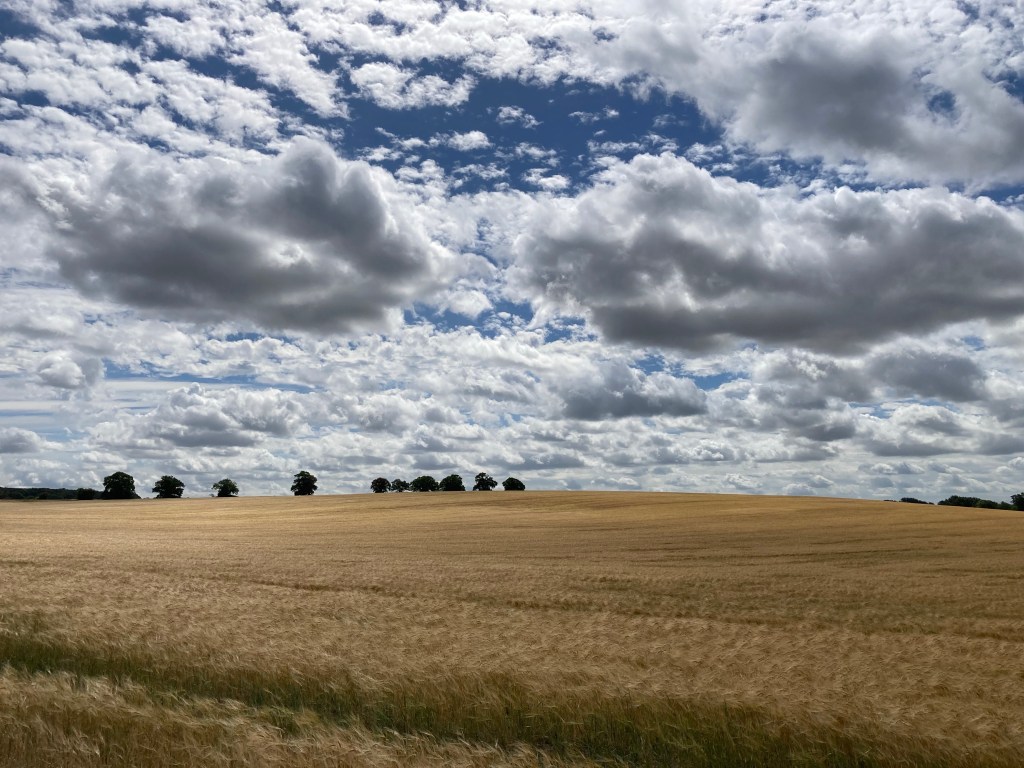
A swathe of barley waving in the breeze
(c) Tim O’Hare, July 2023
About this poem: We moved base for the second week of our summer holiday and after a few less than successful days in Horning in the Norfolk Broads we moved to the village of Redgrave in Suffolk and I instantly relaxed and was happy with walks and runs from the doorstep. For my first morning run there I decided to do a loop of Redgrave and Lopham Fen, memorised a route (or at least thought I had memorised a route) and set out. It was a very enjoyable run but, predictably, I dropped off my planned route and had to use my instinct to find my way back to our accommodation running further and taking a fair bit longer than I had planned. I was not exactly lost, but I did not know exactly where I was and as I was running those words began to play in my mind and the seeds of the poem were sown.
 and a poet